
If you own, manage or are working on a commercial property and have been told it needs to achieve EPC B, you may be wondering what you actually need to do to get there.
This article is based on some of the situations we come across when assessing commercial buildings and preparing EPC improvement plans.
In our experience, there are a few common situations we see:
- A building already has a fairly good EPC, but needs to improve to B as a way to limit non-compliance risks
- An older EPC is reassessed and comes back with a worse rating
- The building owner wants to know which improvements are likely to make the biggest difference
There is no single way to achieve EPC B, as it will depend on the different aspects of the building. Below, we look at what EPC B means, some common scenarios, and the different routes to getting there.
What does EPC B actually mean?
A commercial EPC is an asset rating. An EPC B generally corresponds to an Asset Rating between 26 and 50.
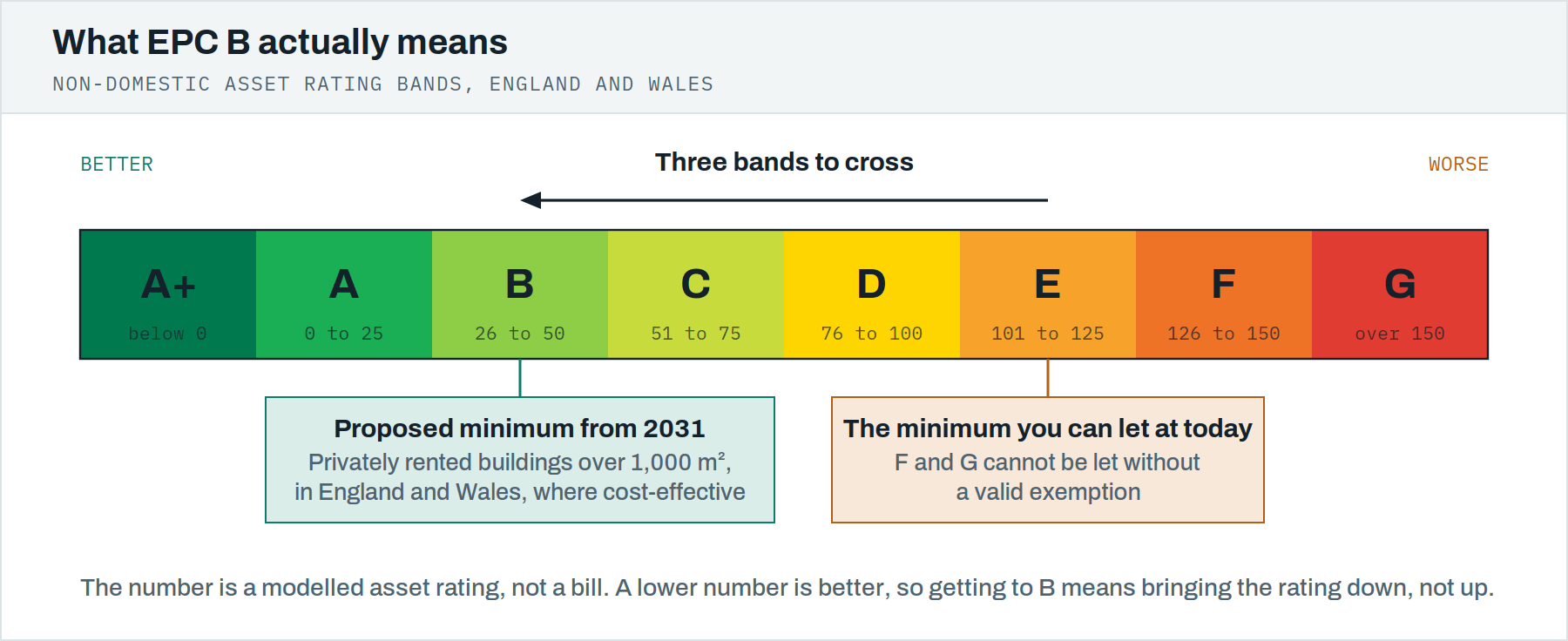
The important thing to understand is that an EPC is not a prediction of exactly how much energy your building will consume.
Think about the energy label on an appliance. It tells you something about its efficiency, but it cannot tell you exactly how much electricity you will use, because that depends on how you use it.
Commercial EPCs work in a similar way. The assessment uses standardised operating conditions to compare buildings, with the current headline non-domestic rating based on modelled carbon emissions.
Why is everyone talking about EPC B?
Well, the Minimum Energy Efficiency Standards (MEES) set minimum EPC requirements for privately rented property. Currently, most privately rented non-domestic properties in England and Wales need to achieve at least EPC E, unless a valid exemption applies.
There has been a lot of discussion about raising this minimum standard. Over the years, the proposed timetable has changed several times, and earlier milestones, such as EPC C by 2027, have now been dropped. However, the longer-term aim of moving larger commercial properties towards EPC B has remained.
In June 2026, the Government confirmed its intention to introduce a minimum EPC B standard from 2031 for privately rented non-domestic buildings over 1,000 m², where this is cost-effective. Buildings below 1,000 m² are proposed to remain at EPC E.
These changes are not yet in force and will require secondary legislation before they become law.

So before doing anything else, establish why your property needs EPC B. It may relate to future MEES requirements, or it could be an investor, lender, lease or internal asset-management requirement.
*It’s worth double checking for updates as the contents of this section may be subject to change.
Why has my commercial EPC got worse?
This is something we see quite a lot when older EPCs are reassessed. A building might have had a C several years ago and then come back as a D. That does not necessarily mean the building itself has got worse.
One likely reason is that the calculation methodology changed. From 15 June 2022, the 2021 National Calculation Methodology came into effect for non-domestic EPCs in England. One of the more significant changes was the way grid electricity was treated. As the grid had become much less carbon intensive, electricity became considerably more favourable in the calculation. Gas appears to have got slightly worse, but only marginally.
This tends to affect buildings that rely heavily on gas heating. It is also worth knowing that the rating compares your building against a benchmark, and that benchmark is likely to have moved as well, which can mean a building slips a band without anything physically changing.
An EPC lodged before June 2022 should stay valid until it expires, so this is usually more about planning ahead than an immediate problem. Wales, Scotland and Northern Ireland made their own changes on separate timescales.
So if your old EPC was a C and the new one is a D, it is worth understanding what has changed before deciding which improvements to look at.

How can I get my commercial property to EPC B?
This is where modelling becomes useful.
Rather than assuming that installing solar panels, adding insulation or replacing a boiler will achieve B, the existing building can be modelled and different improvement scenarios tested.
Scenario 1: I have gas boilers and want to keep them
Start by testing whether EPC B is achievable without replacing the heating system. This could include improvements to:
- insulation and glazing
- airtightness
- boiler efficiency
- heating controls and zoning
- lighting and controls
- ventilation systems
- PV
If heating represents a large proportion of the building’s calculated emissions, however, there may be a limit to how far improvements elsewhere can take the building while retaining gas. The answer is to test it rather than assume.
Scenario 2: My building is already EPC C
If the building fabric, glazing and lighting are already reasonably good, improving them further may only make a small difference to the EPC rating.
At this point, it may be more useful to look at what is still driving the building’s emissions. This could be the heating or cooling system, ventilation, fans and pumps, controls, or the lack of renewable energy.
For some buildings, upgrading the main heating system to a lower-carbon or more efficient system, or adding PV, may have a much bigger impact on the EPC than making further improvements to an already good building fabric.
Scenario 3: I have an older building at EPC D, E or F
There may not be one measure that takes the building straight to B. An options appraisal might look something like this.

These ratings are only illustrative. Every building will behave differently. The point is to establish the pathway before committing to the works.
Scenario 4: Someone has told me to install a heat pump
Electrifying the heating system can significantly improve a carbon-based EPC, but the EPC rating should not be the only thing you consider.
Before replacing gas boilers with heat pumps, you also need to think about heat loss, flow temperatures, emitters, electrical capacity, controls, cold-weather performance and, importantly, how efficiently the heat pump will operate.
The efficiency of the heat pump has a direct impact on running costs. A heat pump with a COP of 3, for example, produces around three units of heat for every one unit of electricity it uses. The higher the efficiency, the less electricity is needed to provide the same amount of heat.
This matters because switching from gas to electricity can increase operating costs if the heat pump is poorly specified or does not perform efficiently in practice.
So while a heat pump may improve the EPC, it still needs to be properly designed and specified for the building. A system can look good in the EPC model and still be the wrong engineering solution in practice.
Where should I start?
If you need to reach EPC B, don’t start by purchasing equipment.
Start with an accurate model of the existing building. Identify what is driving the current rating, then test individual improvements and combinations of measures.

The route might be better fabric. It might be better controls. It might be PV, a change to the heating system or a combination of all of them.
Getting a commercial property to EPC B is ultimately an optimisation exercise, not a checklist.
Sources
- Minimum Energy Efficiency Standards (MEES) in the non-domestic Private Rented Sector: interim response, GOV.UK, 18 June 2026
- https://www.gov.uk/government/consultations/non-domestic-private-rented-sector-minimum-energy-efficiency-standards-epc-b-implementation/outcome/minimum-energy-efficiency-standards-mees-in-the-non-domestic-private-rented-sector-interim-response
- Written statement HCWS126, UK Parliament, 18 June 2026
- https://questions-statements.parliament.uk/written-statements/detail/2026-06-18/hcws126
The MEES position described above is a stated Government intention and requires secondary legislation before it takes effect. This article is general information about assessment and modelling, and is not legal advice on any specific property or lease.
If you have any questions or comments on this content, please contact us here.

Leave a Reply