
What Are IECC Climate Zones?
IECC climate zones classify locations according to their temperature and moisture conditions. They are used by the International Energy Conservation Code (IECC) to determine which building energy-efficiency requirements are appropriate for different climates.
The IECC is published by the International Code Council (ICC) and is used primarily in the United States. Its climate classifications are closely related to those used in ASHRAE Standard 169, although climate zones can also be assigned to locations outside the USA.
How does the IECC climate zone map work?
IECC climate zones range from Zone 1 for the hottest climates to Zone 8 for the coldest.
- Zone 1 = Very Hot
- Zone 2 = Hot
- Zone 3 = Warm
- Zone 4 = Mixed
- Zone 5 = Cool
- Zone 6 = Cold
- Zone 7 = Very Cold
- Zone 8 = Subarctic

Most zones also include a moisture classification:
- A = Moist
- B = Dry
- C = Marine
For example, 2A is a hot, moist climate, while 5B is a cooler, dry climate.
The zones cover more than the contiguous United States. Hawaii and Puerto Rico are in the hot-humid Zone 1 climate, while Alaska includes very cold and subarctic areas within Zones 7 and 8.
What are IECC climate zones used for?
Your climate zone can affect requirements for insulation, U-factors (or U-values), windows, solar heat gain and other aspects of building energy performance.
How do I find my IECC climate zone?
Climate zones are assigned county by county, not by state. That distinction matters because a single state can contain more than one climate zone. Illinois, for example, spans two zones, so simply saying “I’m in Illinois” isn’t an answer if you are trying to identify the correct IECC climate zone for a project.
If your project is in Chicago, you might find yourself searching “Cook County Illinois IECC climate zone” to find the IECC code for Chicago. Looking up Cook County on the IECC climate zone map shows that it sits in Climate Zone 5A.
You can then read the code in two parts. The 5 is the temperature zone, while the A is the moisture classification, with A meaning moist. In other words, 5A is a cool, moist climate.

For compliance work, check the official climate-zone designation and the energy-code edition adopted for your project location.
Find your IECC climate zone
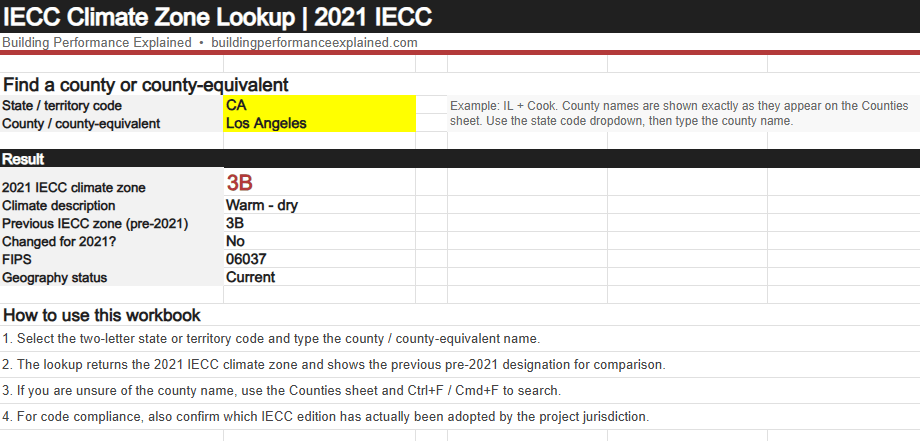
We’ve created a free US IECC Climate Zone Lookup to make it easier to find the 2021 IECC climate zone for your project.
Simply select your state or territory and enter the county or county-equivalent. The tool will return the relevant IECC climate zone and climate classification.
For example, if your project is in Miami, Florida, select Florida (FL) and enter Miami-Dade. The lookup will return Climate Zone 1A – Very Hot Humid.
You can also browse the full US IECC climate zone library by county if you are unsure what to search for.
Download the US IECC Climate Zone Lookup below.
Disclaimer: This tool is provided for general guidance and is based on 2021 IECC climate-zone data. Although some codes were updated in 2024, the Zones remained the same as the 2021 update. The IECC edition adopted can vary between states and local jurisdictions, and local amendments may apply. Always confirm the applicable climate zone and adopted code with the relevant authority before using the information for compliance or design.
You can also look up your Climate Zone online here High-Performance Building Assemblies | Building America Solution Center.
Contact us if you have any comments about the contents of this article.