
Air permeability describes how much air leaks through the building envelope under a specified pressure. In the UK, it is commonly expressed as m³/(h·m²) at 50 Pa.
The tables below provide commonly used airtightness values for different situations, including existing buildings where no test result is available, new-build regulatory requirements, measured buildings, and higher-performance design and retrofit targets.
Use the section that best matches what you are trying to assess, and check the original source before using a value for compliance or certification.
Existing building with no airtightness test
If you are assessing an existing non-domestic building and no airtightness test result is available, the Non-Domestic EPC Conventions provide default air permeability values for EPC assessments.
| Building information | Air permeability used, m³/(h·m²) at 50 Pa |
|---|---|
| Built to 2002 Building Regulations or later, over 500 m² | 10 |
| Built to 2002 Building Regulations or later, 500 m² or less | 15 |
| Built to 1995 Building Regulations | 15 |
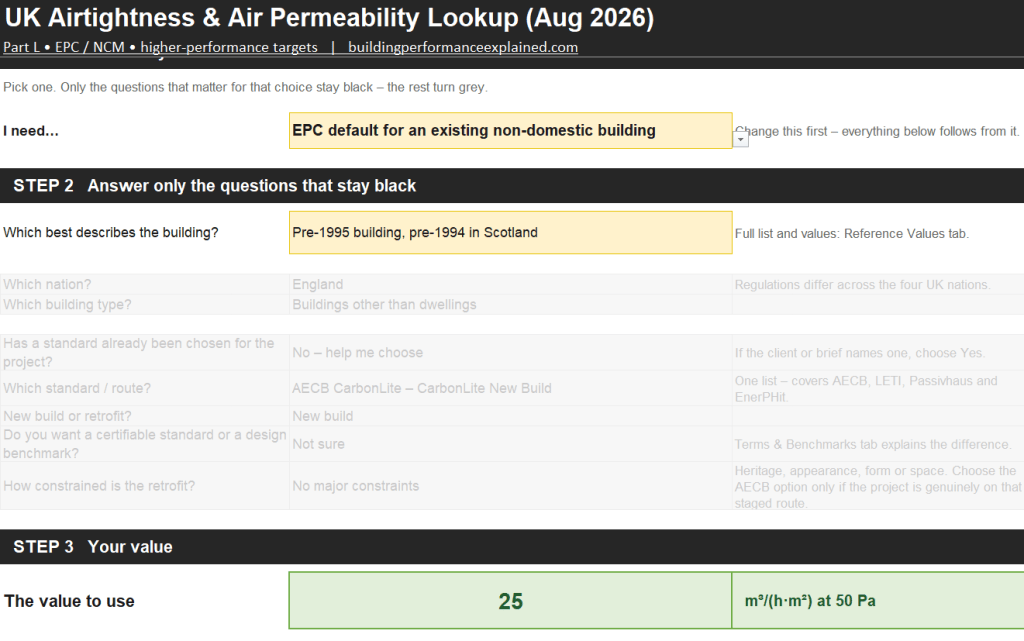
| Pre-1995 building, pre-1994 in Scotland | 25 |
| Pre-1995 building with suitable evidence of particularly high permeability | 35 may be considered |
A value below 10 should only be used under Convention 2.03 where it is supported by an accredited air pressure test result.
These values are EPC methodology assumptions. They are not measured or universal typical airtightness values for every building of that age.

View the Non-Domestic EPC Conventions provided by the NCM (National Calculation Methodology) or download our UK Air tightness look-up tool below:
New buildings: what do the regulations say?
The UK does not have one single airtightness requirement. The applicable guidance depends on whether the project is in England, Wales, Scotland or Northern Ireland.
| Nation | Dwellings, m³/(h·m²) at 50 Pa | Buildings other than dwellings, m³/(h·m²) at 50 Pa | Type of value |
| England | 8 | 8 | Limiting value |
| Wales | 8 | 8 | Limiting value |
| Scotland | 7 or better | 7 or better | Recommended design value |
| Northern Ireland | Maximum 10 | Maximum 10 | Maximum permissible value |
For Northern Ireland, the guidance also states that buildings would normally be expected to achieve an air permeability of 5 or less.
For Scotland, the Technical Handbooks do not set the same type of maximum air permeability as England, Wales and Northern Ireland. They recommend designing new buildings to achieve 7 m³/(h·m²) at 50 Pa or better.
A regulatory limiting value is not necessarily a recommended design target. A project may need to achieve a lower air permeability to satisfy its energy calculation or project requirements.
Always check which edition of the Building Regulations applies to the project, as transitional arrangements may apply. (See sources below).
What if I already have an airtightness test result?
If a valid measured airtightness result is already available, this provides building-specific information rather than relying on a generic assumption.
Use the measured result where the relevant assessment or calculation methodology allows or requires it.
Before using a result, check the unit, test pressure, part of the building tested, test date and whether the result is suitable for the assessment you are carrying out.
What airtightness should I aim for?
Building Regulations limits are not the same as higher-performance design targets.
If you are designing a new building or carrying out a retrofit and want to go beyond minimum regulatory requirements, voluntary standards and industry guidance provide useful benchmarks.
AECB CarbonLite targets
| AECB CarbonLite route | Air permeability target, m³/(h·m²) at 50 Pa |
| Retrofit Step-by-Step, Step 1 | ≤5 |
| CarbonLite Retrofit | ≤2 |
| CarbonLite New Build | ≤1.5 |
These are voluntary AECB CarbonLite performance standards rather than Building Regulations requirements.
View the AECB CarbonLite Standards
LETI new-build target
The LETI Climate Emergency Design Guide gives the following indicative airtightness target across its new-build archetypes, including housing, offices and schools.
| LETI guidance | Air permeability target, m³/(h·m²) at 50 Pa |
| New-build design guidance | <1 |
View the LETI Climate Emergency Design Guide
LETI home retrofit targets
LETI reports its home retrofit targets using air changes per hour at 50 Pa, rather than m³/(h·m²).
| LETI home retrofit level | Airtightness target |
| Best practice, constrained retrofit | 3.0 ACH50 |
| Best practice, unconstrained retrofit, cool temperate climate | 2.0 ACH50 |
| Best practice, unconstrained retrofit, cold climate | 2.0 ACH50 |
| Exemplar, all retrofit types | 1.0 ACH50 |
Do not directly compare these ACH50 values with Part L, AECB or LETI new-build air permeability values. ACH50 normalises the leakage by building volume, while m³/(h·m²) normalises it by envelope area.
View the LETI Climate Emergency Retrofit Guide
Is my airtightness result good or bad?
Generally, a lower result means a more airtight building when the same metric and test pressure are being compared.
However, there is no single airtightness number that is automatically good for every building. The result should be compared with the regulatory requirement, design target or voluntary standard that applies to that particular project.
A very airtight building also needs an appropriate ventilation strategy. Airtightness controls unwanted leakage, while ventilation provides the intentional fresh air required by the building.
How do I get an airtightness test?
A measured airtightness result is obtained through an air leakage test.
One common method is fan pressurisation, often called a blower door test. A calibrated fan creates controlled pressure differences between inside and outside, and the airflow required to maintain those pressures is measured.
CIBSE TM23 also covers low-pressure pulse testing. The appropriate testing method depends on the purpose of the test and the applicable regulatory or certification requirements.
For formal assessments, use an appropriately competent or registered airtightness tester.
CIBSE TM23: Testing Buildings for Air Leakage
Airtightness globally
Airtightness is not reported in exactly the same way everywhere. The UK commonly uses air permeability in m³/(h·m²) at 50 Pa. Across Europe, particularly with Passivhaus, you may see n50 or ACH50, which relates leakage to building volume. ACH50 and CFM50 are also common in North America, where testing is often called blower door testing. The work used to reduce leakage is commonly called air sealing in the US. Always check the unit and test pressure before comparing results.
We will cover airtightness, testing methods, terminology and international differences in more detail in our upcoming Building Airtightness Explained blog. Stay tuned.
If you have any questions or would like to get in touch, please contact us.
Sources and further reading
Scottish Building Standards: Domestic Technical Handbook
Scottish Building Standards: Non-domestic Technical Handbook
Northern Ireland Technical Booklet F1
Northern Ireland Technical Booklet F2
LETI Climate Emergency Design Guide
LETI Climate Emergency Retrofit Guide
CIBSE TM23: Testing Buildings for Air Leakage
Values and guidance should always be checked against the edition applicable to the specific project.